Sheetrock vs Drywall vs Plaster: What's the Difference?
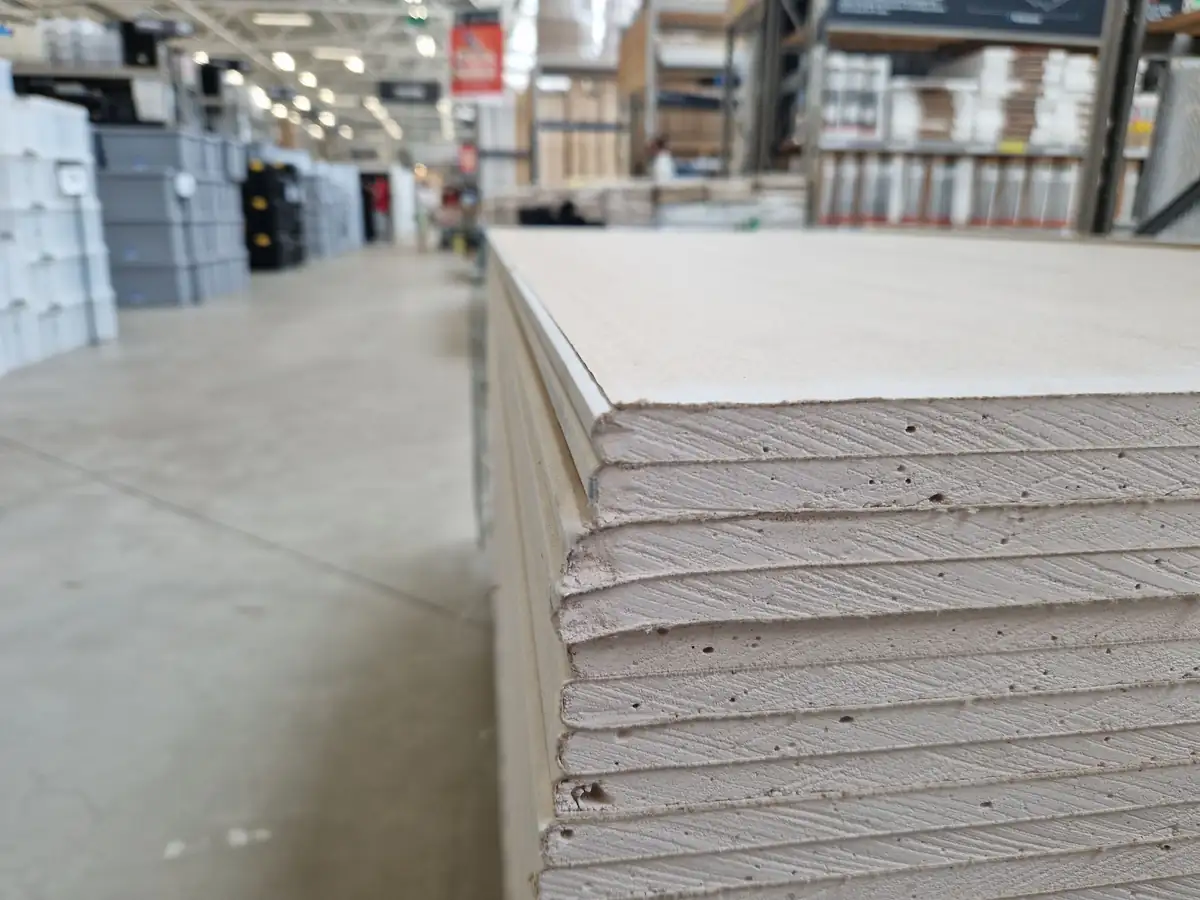
There's no difference between Sheetrock and drywall. Sheetrock is a brand name for gypsum drywall, and wallboard, gypsum board and plasterboard all mean the same panel. Plaster walls are another material: they're harder, thicker and usually found in houses built before about 1950, and they crack and patch differently.
What you need
6 items needed · tick what you already own
- Raking light across the wall shows ridges and dips you can't see in normal light.
- Pressing spackle into nail holes, dents and small holes, and scraping off loose paper and paint.
- Cutting loose paper, scoring drywall, trimming torn tape and opening cracks into a shallow V.
- Filling deep holes and gaps, the first coat over mesh tape, and repairs you want to finish in one day.
- Self-sticking tape for cracks and flat patch seams. Easy for beginners because nothing has to be bedded first.
- Bedding tape, first coats over patches and cracks, and most repairs up to about 4" wide.
Popular picks on Amazon
- Sheetrock Easy Sand 20 setting compoundFast-setting powder for deep fills and first coats, on drywall or plaster.
- Sheetrock Plus 3 lightweight joint compoundPremixed, lightweight compound for skim coats and finish coats.
- Franklin Sensors ProSensor stud finderHelps tell drywall from plaster and find studs or lath before you cut.
Widely used options, not products we have tested. Check current reviews before you buy. As an Amazon Associate we earn from qualifying purchases. Disclosure
Sheetrock vs drywall
Sheetrock is a registered brand name for gypsum drywall panels made by one US manufacturer. It has been around so long that many people use it for any drywall, the way people say "tissue" or "duct tape" for products from many makers. When a contractor says "hang sheetrock" or "the rock," they mean drywall from whatever maker the supplier stocks.
For a repair, the brand on the back of your wall doesn't matter. What matters is the thickness and the type: standard, moisture-resistant, mold-resistant or fire-rated. Our guide to types of drywall shows how to measure what you have.
Is gypsum board drywall?
Yes. Gypsum board is drywall. These names all describe the same thing, a gypsum core between two layers of paper (or fiberglass on some mold-resistant panels):
- Drywall: the common US name. "Dry" because it goes up as finished sheets instead of wet plaster.
- Gypsum board or gypsum wallboard: the technical name used in building codes.
- Wallboard: an older general term.
- Plasterboard: the usual name in the UK and some other countries. It's still drywall, not plaster.
- Sheetrock, rock, gyp board: trade slang.
What is "drywall plaster"?
People usually mean joint compound, the mud used to tape seams and patch holes. Sometimes they mean veneer plaster, a thin coat of real plaster troweled over a special drywall base. Ordinary drywall repairs use joint compound. See types of drywall mud.
Plaster vs drywall
Before drywall took over in the decades after World War II, most interior walls in US houses were plaster. Plaster goes on wet in two or three coats over a base called lath. Older houses have wood lath, thin strips nailed across the studs with gaps between them. Mid-century houses often have rock lath, gypsum boards about 16" × 48" that look a lot like small drywall sheets. The plaster pushes through the gaps or grips the lath face, and those hardened lumps behind the wall, called keys, hold it on.
| Plaster walls | Drywall | |
|---|---|---|
| Total thickness | Usually about ⅞–1" with the lath | Usually ½" or ⅝" |
| Durability | Very hard surface. Resists dents | Softer. Dents and gouges more easily |
| Sound | Dense and quiet between rooms | Transmits more sound unless insulated or doubled |
| Cost to install new | High. Skilled, slow labor | Low. Fast to hang and finish |
| How it cracks | Spiderweb and diagonal cracks, cracks from door and window corners, loose areas that sag away from the lath | Straight cracks along seams and corners, nail pops, tape bubbles |
| Repair approach | Re-attach loose areas, fill with setting compound or plaster, mesh tape over cracks | Spackle, mesh patches, new drywall pieces, all-purpose compound |
| Hanging pictures | Drill a pilot hole. Nails can crack it | Nails and anchors go in easily |
How to tell plaster from drywall
You can usually tell in a few minutes without opening the wall.
- Check the age of the house. A house built before about 1940 almost always has plaster unless it was remodeled. Houses from the 1940s and 1950s can have either. Most houses built after about 1960 have drywall, though some have veneer plaster.
- Knock on the wall. Rap between studs with your knuckle. Drywall sounds hollow and gives a little. Plaster sounds dull and solid and feels like knocking on stone.
- Try a thumbtack. Push a thumbtack into a spot that will be hidden, like inside a closet. It goes into drywall with thumb pressure. Plaster stops it cold.
- Look at an outlet edge. Turn off the power and remove a cover plate. Drywall shows a clean gray gypsum edge with paper on both faces, about ½" thick. Plaster shows a thicker, layered edge, and you may see wood lath strips or gray rock lath behind it.
- Look at the cracks. Long straight cracks at seams, and screw heads popping in a neat grid, mean drywall. Wandering spiderweb cracks and bulges mean plaster.
- Look from behind. In an unfinished attic, basement or closet, you might see the back of the wall. Rows of wood strips with lumps of plaster squeezed between them are wood lath.
Old walls, old materials: in homes built before 1978, assume painted surfaces may contain lead. Some older plaster, texture and joint compound contained asbestos. Have it tested by an accredited asbestos professional before you sand, scrape or cut; EPA advises against taking samples yourself.
Why it matters for repairs
Drywall repair methods don't always work on plaster:
- Premixed mud alone fails in deep holes. Plaster holes are often ¾" deep or more. All-purpose compound shrinks and cracks at that depth. Setting compound or base-coat plaster is the right filler.
- Loose plaster has to be re-attached first. If the plaster has broken its keys, patching over it just moves the crack. Plaster washers and screws pull it back to the lath.
- Thickness doesn't match. A ½" drywall patch in a 1" plaster wall needs shims behind it to sit flush.
- Cutting is harder. A drywall saw dulls fast and cracks plaster around the cut. Score deep with a utility knife or use an oscillating tool, and cut slowly.
Our plaster wall repair guide covers cracks, loose plaster and holes down to the lath step by step.
Should you replace plaster with drywall?
Usually not just for a repair. Plaster that is mostly sound can be patched for far less than tearing it out, and demolition is messy, dusty work that can disturb lead paint. If a whole wall is loose and cracked everywhere, the common fixes are skim coating it, laminating ¼" or ⅜" drywall over it with screws into the studs, or removing it and hanging new drywall. A plasterer or drywall contractor can tell you which makes sense for your wall.
Drywall alternatives
Drywall is the cheapest way to cover a wall, but it isn't the only one:
- Plaster veneer: a thin coat of real plaster over a special blue-faced gypsum base. It's harder than drywall and finishes the same day, but it needs a skilled plasterer.
- Paneling: wood or wood-composite sheets, including beadboard. Quick to put up and hides uneven walls. Under the 2021 IRC (section R702.5), wood veneer and hardboard paneling thinner than ¼" needs at least a ⅜" drywall backer (2021 IRC, chapter 7, checked November 2026). Over foam insulation or on a garage wall, you'll need drywall behind it too.
- Cement board: the standard backer for tile in showers and other wet areas. Not a finished wall surface on its own.
- Wood planks: tongue-and-groove boards or shiplap nailed to the studs. Durable and easy to repair one board at a time, but more expensive in material and labor.
Check local code before you skip drywall. Under the 2021 International Residential Code, exposed foam insulation needs a covering such as ½" drywall (section R316.4), and the wall and ceiling between a garage and the house need drywall on the garage side, with ⅝" Type X on a garage ceiling with rooms above (section R302.6) (2021 IRC, chapter 3, checked November 2026). Codes are adopted locally: your state or city may use an older or newer edition, or amend it, so confirm with your building department.
Common questions
Are plaster walls better than drywall?
Plaster is harder and quieter, but it costs much more to install and is harder to patch and cut. Drywall is cheaper and simpler to fix. Neither is better in every way.
Can I use spackle on plaster?
For nail holes and small dings, yes. For anything deeper than about ¼" or wider than a few inches, use setting compound. See joint compound vs spackle.
Related guides
- Types of drywall mudDrywall mud types explained: all-purpose, lightweight, taping, topping and hot mud set times, bucket vs box vs…
- Crack repairDrywall crack repair step by step: why cracks come back, when to tape, how to fix hairline cracks, wall-ceiling…
- Joint compound vs spackleJoint compound vs spackle: how they differ in shrinkage, drying time and sanding, which one to use for each…
- Skim coat drywallHow to skim coat drywall with joint compound: when a wall needs it, sealing torn paper, thinning the mud, roller…