How to Repair Water Damaged Drywall
Fix the source of the water, dry the area with fans and a dehumidifier for 2–5 days, and check it with a moisture meter against a dry part of the same wall. If the board is firm, seal the stain with a shellac or oil-based stain-blocking primer and paint. If it's soft, crumbling, swollen or moldy, cut it out to the studs well above the wet line, replace wet insulation, and hang new drywall.
- Time
- 3–6 h of work over 3–7 days
- Skill
- Moderate
- Drying
- 2–5 days to dry the wall, then 12–24 h per coat

What you need
14 items needed · tick what you already own
- Checking that drywall has dried out after a leak before you patch and paint.
- Cutting loose paper, scoring drywall, trimming torn tape and opening cracks into a shallow V.
- Cutting damaged drywall out to a clean square or rectangle before you patch.
- Driving screws into backer boards, repair clips and studs, and fixing nail pops.
- Attaching patch pieces and backer boards, and re-securing popped nails.
- Filling holes larger than about 6", and California (butterfly) patches.
- Seams, inside corners and recurring cracks. It's stronger than mesh once bedded properly.
- Filling deep holes and gaps, the first coat over mesh tape, and repairs you want to finish in one day.
- Skim coats over patches and tape, and feathering repairs wider. Sands easily.
- Bedding tape, first coats over patches and cracks, and most repairs up to about 4" wide.
- Wide final coats that feather a patch or seam into the wall so it disappears under paint.
- Sanding small patches by hand with less dust and fewer gouges than sandpaper.
- Sealing patched compound so paint doesn't look dull over it (flashing), and blocking water stains.
- Sanding compound makes fine dust. Ceiling work drops it straight toward your eyes.
Stop the water first
Nothing you do to the wall lasts if the water keeps coming.
- Plumbing leak: shut the water off at the fixture valve or the main.
- Roof or window leak: the stain grows after rain. The leak may be several feet from the stain.
- Bathroom splash or failed caulk: damage low on the wall beside a tub or shower. Recaulk first.
If water is near outlets, switches or a light fixture, turn off that circuit at the breaker before you go any further. If you can't find the source, or it's inside a wall you can't open, call a plumber or roofer first.
Dry the wall completely
Drywall soaks up water like a sponge, and the inside of the wall dries much more slowly than the face.
- Get air moving. Point one or two box fans or air movers at the wet area and run a dehumidifier in the closed room. Open the room up if the air outside is drier.
- Open the wall a little. Pull the baseboard and drill a few 1" holes in the drywall near the floor, between the studs, so air can reach the cavity. The baseboard hides them later.
- Give it time. A small leak usually dries in 2–3 days. A soaked wall can take 5 days or more. Cold, humid weather slows it down.
- Measure, don't guess. A pin or pinless moisture meter tells you when you're done. Take a reading on a dry part of the same wall, then on the damaged area. When the readings match, the board is dry.
Mold starts fast. Wet drywall can start growing mold within 24–48 hours (EPA, A Brief Guide to Mold, Moisture and Your Home, checked November 2026). If you can't get it drying within a day or two, plan on cutting it out rather than saving it.
Patch or replace: how to decide
Once it's dry, press on the stain with your thumb and probe it with a screwdriver. Firm board can stay. Board that gives, crumbles or has lost its paper face has to go.
| What you find | What it means | Fix |
|---|---|---|
| Firm board, brown stain or ring, paint intact | Surface stain only | Stain-blocking primer, then paint |
| Firm board, paint bubbled or peeling | Paper face is fine, paint lost its bond | Scrape, skim with compound, prime, paint |
| Soft or spongy when pressed | Gypsum core has broken down | Cut out and replace |
| Crumbling edges or a screwdriver pushes through | Board has lost its strength | Cut out and replace |
| Swollen, wavy or sagging | Board has absorbed water and deformed | Cut out and replace |
| Paper face peeling away from the core (delaminated) | The board won't hold compound or paint | Cut out and replace |
| Black, green or fuzzy spots, or a musty smell | Mold | Cut out and replace (see mold section) |
Fixing a stain on firm drywall
Regular primer and paint won't cover a water stain. It bleeds back through in a few days. Seal it with a shellac-based or oil-based stain-blocking primer, extending 2–3" past the stain. One coat usually works. Two coats on dark stains. Then paint to the nearest corners so the repair doesn't show.
How to replace water damaged drywall
This is the repair for soft, swollen or moldy board. You cut from stud to stud so the new piece has something solid to screw to on every edge.
Before you cut: turn off power to outlets and switches on that wall. Make a shallow first cut and look inside with a flashlight for wires, pipes and ducts. In homes built before 1980, joint compound and textures can contain asbestos. Have them tested by an accredited asbestos professional before you cut or sand, even for a small section (EPA). If your home was built before 1978, test the paint for lead before you scrape, sand or cut it (EPA, Lead-Safe Practices for Do-It-Yourselfers, checked November 2026).
- Mark the cut line. Find the highest point of the damage, then mark a level cut line well above it. Water wicks up inside the board past the visible stain, so check above the line with the moisture meter and keep going until the board tests dry.
- Cut out the damage. Score along your line with a utility knife or cut with a drywall saw, keeping the blade shallow. Cut the vertical edges along the center of the studs so half the stud is left for the new piece. Pull the old drywall off and remove leftover fasteners.
- Deal with the insulation. Wet fiberglass insulation sags and holds water against the studs. Pull it out, bag it and replace it once the cavity is dry. Wipe down the studs and check them with the moisture meter. Dry the studs until your moisture meter reads the same as dry framing nearby, or as the meter maker recommends for wood, before you close the wall.
- Hang the new drywall. Cut the new piece to fit with about ⅛" gap at the edges. Match the old thickness, usually ½". In bathrooms and laundry rooms, use moisture-resistant board. Screw it every 8" along the edges and 12" in the field, with screws ⅜" in from the edge and the heads just below the surface.
- Tape the seams. Bed paper tape in a full layer of compound over each joint with a 6" knife. Setting compound is strongest for this coat. Fill the screw heads as you go.
- Finish coats. Add two more coats with a 10" or 12" knife, each one wider than the last. Let premixed compound dry 12–24 hours between coats. See taping and mudding drywall for the full technique.
- Sand, prime and paint. Sand smooth with a fine sponge, prime the new board and compound, and match the wall texture if there is one. The drywall texture guide covers orange peel and knockdown.
Water damaged drywall ceiling repair
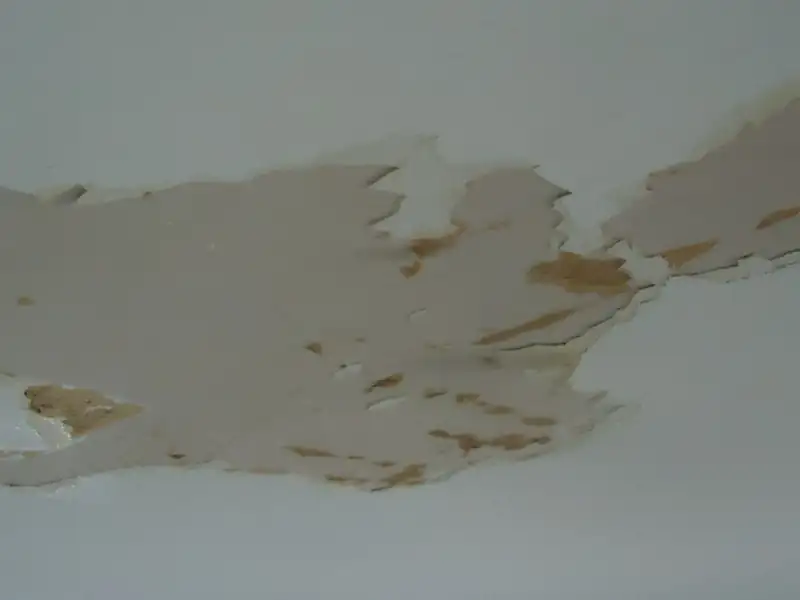
Ceilings collect water from roofs, upstairs bathrooms and attic condensation. The danger is weight: wet drywall is heavy, and a bulging ceiling full of water can come down all at once.
If the ceiling is sagging or bulging: keep people and pets out from under it. If the bulge is small and there's no light or fan nearby, turn off power to the room, put a bucket under the lowest point and poke a small hole from the side to let the water drain. If a large section is sagging, or the bulge is bigger than a dinner plate, stay out from under it and call a pro. Waterlogged drywall can fall without warning.
Once it's drained and dry, the same patch-or-replace rules apply. Ceilings are harder: you work overhead, and the board is often ⅝" and textured. Cut back to the joists, put a screw near each corner and along each edge, space screws about 12" apart along the joists (nails 7"), and get a helper for anything over a couple of square feet. On a fire-rated ceiling, such as a garage ceiling under living space, follow the rated design or local code. The ceiling drywall repair guide covers working overhead and safe ladder use.
Mold on water damaged drywall
Mold on drywall grows into the paper face and the core. You can't scrub it out of drywall the way you can from tile. The fix is to remove the affected board.
- Small areas you can handle: the EPA's guidance treats mold covering less than about 10 square feet (roughly a 3' × 3' patch) as a job most homeowners can do themselves (EPA, A Brief Guide to Mold, Moisture and Your Home, checked November 2026).
- Protect yourself: wear an N95 respirator, goggles without vent holes and long rubber or nitrile gloves. Mist the area lightly with water before cutting to keep spores down. Bag the old drywall in heavy plastic before you carry it through the house.
- Call a pro for: mold over about 10 sq ft, mold that keeps coming back, anyone in the house with asthma or a weak immune system, or water from a sewage backup or flood. Sewage water carries bacteria, and everything it touched (drywall, insulation, carpet) needs professional cleanup.
Insurance photos and records
Sudden damage like a burst pipe may be covered by homeowners insurance. Slow leaks often aren't. Document it before you start.
- Photograph the stain, the source of the leak and the wet line, with a tape measure in the shot for scale.
- Take photos of the moisture meter readings next to the damaged area and the dry wall.
- Keep the failed part and your receipts.
- Call your insurer before you tear out large sections. They may want an adjuster to see it first.
Related repairs
- Ceiling repairCeiling drywall repair step by step: fix ceiling cracks, patch holes from fixtures, work safely overhead, handle…
- Large holesHow to patch a large hole in drywall with repair clips, wood backer strips or a California patch. Steps, tools and…
- Bulging drywallBulging drywall and drywall seams bulging: how to tell nail pops, crowned seams, bowed studs and water damage…
- Drywall textureDrywall texture types (orange peel, knockdown, popcorn, skip trowel) and how to texture a drywall patch so it…