Drywall Anchors: Which Type to Use and How to Read Load Ratings
Use a self-drilling anchor for frames and light decor, a toggle bolt or strap toggle for shelves, mirrors and curtain rods, and a screw into a stud for TVs, grab bars, cabinets and anything that takes a pull or a lean. Check the maker's published rating for your wall thickness and for wall or ceiling use, and plan on only a fraction of it as a working load.
- Time
- 5–15 min per anchor
- Skill
- Easy
- Drying
- None
What you need
6 items needed · tick what you already own
- Driving screws into backer boards, repair clips and studs, and fixing nail pops.
- Cutting loose paper, scoring drywall, trimming torn tape and opening cracks into a shallow V.
- Pressing spackle into nail holes, dents and small holes, and scraping off loose paper and paint.
- Nail holes, screw holes, dents and holes up to about 1" (our rule of thumb; some spackles are labeled for larger holes, so follow the label). It dries fast and barely shrinks.
- Sanding small patches by hand with less dust and fewer gouges than sandpaper.
- Sanding compound makes fine dust. Ceiling work drops it straight toward your eyes.
Popular picks on Amazon
- E-Z Ancor Twist-N-Lock self-drilling anchorsScrew-in nylon anchors for pictures, frames and light shelves. No pilot hole.
- TOGGLER SnapToggle toggle boltsStrap toggles for heavier shelves, mirrors and curtain rods in hollow drywall.
- Cobra Triple Grip anchor kitRibbed plastic anchors with screws in several sizes for everyday hanging.
- Franklin Sensors ProSensor stud finderShows the full width of a stud, so you can screw into wood when the load is heavy.
Widely used options, not products we have tested. Check current reviews before you buy. As an Amazon Associate we earn from qualifying purchases. Disclosure
Types of drywall anchors compared
A bare screw crumbles drywall and pulls out. An anchor spreads the load by expanding, by gripping with coarse threads, or by opening up behind the wall. The more of the back face it grabs, the more it holds.
| Type | How it holds | Relative holding power | Good for |
|---|---|---|---|
| Plastic expansion (smooth cone) | Expands in a drilled hole as the screw goes in | Lowest | Small frames, light decor, smoke detectors |
| Ribbed plastic | Ribs and fins resist spinning and pull-out | Low | Frames, light towel hooks, small shelves |
| Self-drilling nylon (threaded) | Coarse threads cut into the gypsum | Low to medium | Frames, mirrors, light curtain rods |
| Self-drilling zinc (metal threaded) | Same, with a stronger body and sharper point | Medium | Curtain rods, heavier mirrors, coat hooks |
| Molly (hollow-wall anchor) | Metal sleeve collapses and flares behind the board | Medium | Towel bars, shelf brackets, permanent fixtures |
| Toggle bolt (spring wing) | Wings spring open behind the wall | High, by bolt size | Shelves, heavy mirrors, ceiling hooks |
| Strap toggle | Metal channel turns flat behind the wall, held by a plastic strap | Highest of the hollow-wall anchors | Heavy shelves, wall cabinets between studs, ceilings |
| Screw into a stud | Threads bite into solid wood | Highest; a #8 or #10 wood screw is far stronger than any hollow anchor | TVs, grab bars, cabinets, handrails |
Plastic vs metal drywall anchors
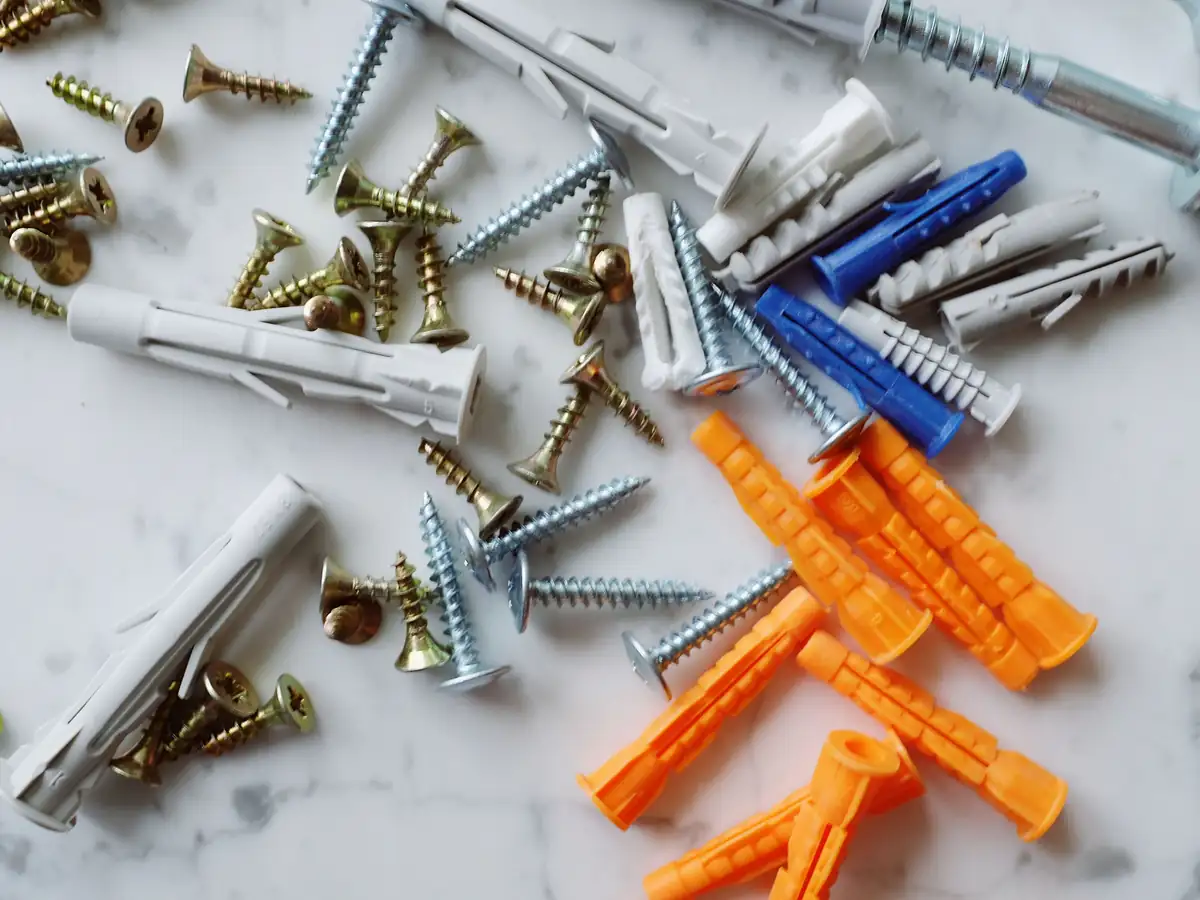
Plastic drywall anchors are cheap and fine for light, still loads. Metal drywall anchors (zinc self-drilling, mollies, steel toggles) hold more and don't crack with age. The best drywall anchors are the ones sized for the job. Heavy duty drywall anchors, toggle bolts and strap toggles, open up behind the board; hollow wall anchors (mollies) sit in between. Use the drywall anchor screws that come in the pack: too thin won't expand the anchor, too fat splits it.
Why there are no pound figures here: a rating only means something for one specific anchor, in one wall material, with the load pulling in one direction. Use the rating the maker publishes for the exact anchor you buy, in your wall thickness, for wall or ceiling use. The next section explains how to read it.
How much weight anchors really hold
Shear vs pull-out
Shear is the load straight down along the wall, like a picture on a hook. Pull-out (tension) pulls the anchor straight out, like a shelf bracket levering forward or anything on a ceiling. Small plastic and self-drilling anchors usually hold much less in pull-out than in shear. Toggles can hold about the same either way: TOGGLER's sheet rates its SnapToggle BB slightly higher in pull-out than in shear in ½" drywall (TOGGLER SnapToggle technical sheet). Check both numbers on the sheet for the anchor you buy.
Shelves turn a downward load into pull-out at the top screw of each bracket, so use toggles or studs, not plastic anchors.
Ultimate load vs working load
Many makers publish the ultimate load, the point where the anchor failed in a lab test. That isn't the weight to hang. One maker, TOGGLER, says industry safety standards recommend about one quarter of the ultimate load as a reasonably safe working load, and that its figures are for objects held close to the wall (TOGGLER FAQ, checked November 2026). DEWALT's toggle bolt sheet says the same: its ultimate loads "must be reduced by a minimum safety factor of 4.0" (DEWALT toggle bolt product data). Other makers print a working load with the safety margin already built in. Read the package or the maker's technical sheet to see which number you're looking at.
Any rating also assumes sound, dry drywall. Old, damaged, water-softened or crumbly board holds less. Weight that sits farther from the wall, like a deep shelf or a TV on an extending arm, levers on the anchor and cuts what it can hold.
½" vs ⅝" drywall
Most interior walls in US homes are ½" drywall. Ceilings, garages and walls next to garages are often ⅝" fire-rated board. Thicker board gives an anchor more to grab, so makers often list separate ratings for ½" and ⅝". Check that the anchor's grip range covers your wall: a molly sized for ½" won't flare properly in ⅝". Plaster walls are harder and brittle, and self-drilling anchors crack them.
Ceilings
Everything on a ceiling is pure pull-out, and gravity never stops. Don't use plastic expansion or self-drilling anchors overhead for anything that matters. Use a toggle bolt or strap toggle for plants and hooks, and screw into a joist for anything heavy or anything that moves. Ceiling fans need a fan-rated box fastened to framing. Don't hang anything from a sagging or stained ceiling; see ceiling drywall repair.
Which anchor to use for what
| Item | Best choice | Notes |
|---|---|---|
| Small frames, clocks | Picture hook, ribbed plastic or self-drilling nylon | One anchor is fine |
| Large frames, mirrors | Self-drilling zinc or toggle bolts, two points | Hang from two anchors so it stays level |
| Curtain rods | Stud where possible, otherwise zinc self-drilling or toggles | Curtains get yanked; brackets near the window edge often hit the header framing |
| Floating and bracket shelves | Studs, or toggle bolts / strap toggles | Loaded shelves pull out at the top screw |
| Towel bars, toilet paper holders | Molly or toggle | They get pulled daily; plastic loosens |
| TV mounts | Studs only | Use the lag bolts that come with the mount |
| Grab bars | Studs or solid blocking only | Never hollow-wall anchors; a fall puts a sudden, heavy load on it |
| Wall cabinets | Studs, with a ledger while you hang | Loaded cabinets weigh far more than they look |
Find studs first
A screw in a stud beats any anchor, so look before you drill. Studs in most US homes sit 16" apart on center, sometimes 24". Outlet and switch boxes are usually fastened to one side of a stud, so measure from there. A stud finder speeds this up, and a thin finish nail confirms it: solid resistance means wood. If a stud is 2" from where you want the item, screw a board across two studs and hang from that.
Grab bars and TV mounts need studs or blocking (a horizontal 2x between studs). Opening the wall to add blocking is a normal job; patch it like any large hole.
Before you drill: avoid the zones straight above and below outlets and switches, where wires run, and the wall behind sinks and toilets, where pipes run. Drill slowly, and stop if you hit metal behind the board. Nail plates on studs mean a wire or pipe is there.
How to install a self-drilling anchor
- Mark and check. Mark the spot. Push a thin nail in to make sure you're not on a stud. If you hit wood, skip the anchor and drive the screw straight into the stud.
- Start the point. Fit a #2 Phillips bit in your drill or use a screwdriver. Press the anchor's point into the mark, square to the wall, and tap it lightly with a hammer to seat it if it skates.
- Drive it in slowly. Use low speed and steady pressure until the head sits flush with the wall. Stop as soon as it's flush. High speed or one turn too many spins the threads and strips the gypsum.
- Attach the item. Drive the supplied screw through your hook or bracket into the anchor, snug but not hard. Overtightening is the most common way these anchors fail.
How to install toggle bolts for drywall
- Drill the hole. Drill the hole size printed on the package for the exact toggle you bought, because it differs by type and maker. Two examples: DEWALT spring-wing toggle bolts call for a ⅜" hole for ⅛" bolts, ½" for 3⁄16" and ⅝" for ¼" in wallboard (DEWALT toggle bolt product data, checked November 2026). TOGGLER SnapToggle BA and BB strap toggles take a ½" hole (TOGGLER SnapToggle technical sheet, checked November 2026).
- Thread the bolt through the item first. Pass the bolt through your bracket or hook, then thread the wings onto the end, with the wings opening toward the bracket. You can't add the bracket after the toggle is in the wall.
- Push it through. Fold the wings flat and push them through the hole until you feel them snap open inside the cavity.
- Pull and tighten. Pull the bracket toward you so the wings press against the back of the drywall, then tighten the bolt until the bracket is snug. Don't crank it, or the wings crush into the gypsum.
Strap toggles go in a similar hole: slide the channel in, pull the strap tight, push the cap to the wall, snap off the strap and bolt on. The anchor stays put if you remove the bolt.
How to remove anchors cleanly
- Plastic expansion anchors: back out the screw, thread it in two or three turns and pull straight out with pliers. If it resists, tap it into the cavity with a screwdriver.
- Self-drilling anchors: unscrew them counterclockwise with a Phillips screwdriver, slowly, so the threads don't tear the face paper.
- Mollies: remove the screw, then cut the flange flush with a utility knife and tap the sleeve slightly below the surface.
- Toggle bolts: unscrew the bolt and let the wings drop inside the wall.
The hole that's left is usually ¼" to ⅝". Fill it in two thin passes, sand and prime. The steps are in patching small holes in drywall. If an anchor tore out and left a hole bigger than a golf ball, use a mesh patch from how to patch drywall.
A note on wall weight limits
There's no single weight limit for a drywall wall. The limit is the fastener, how many you use and the direction of the load. Spread heavy loads over several anchors, tie anything you pull on or that could fall on someone into framing, and treat a published rating as an upper limit, never a target. An anchor that feels loose on day one won't get tighter: move over an inch and go bigger, or find the stud. If the board itself is loose or popping fasteners, refasten it first; see drywall screws vs nails.
Related repairs
- Small holesHow to patch small holes in drywall with spackle: nail holes, screw holes, anchor holes and dents up to 1½". When…
- How to patch drywallHow to patch a hole in drywall: the right method for nail holes, doorknob holes and big holes, the tools you need,…
- Large holesHow to patch a large hole in drywall with repair clips, wood backer strips or a California patch. Steps, tools and…
- Drywall repair toolsThe drywall repair tools you actually need: an 8-item starter kit, the tools for each repair, what pros use that…